
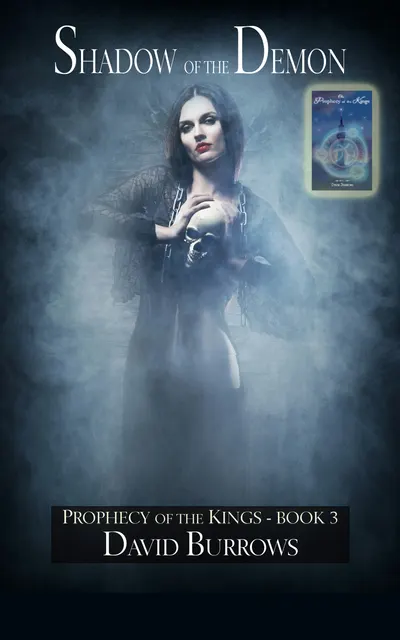
The Prophecy of the Kings · Book 3
Shadow of the Demon
War burns on the very brink of Hell.
Shadow of the Demon is the third novel in The Prophecy of the Kings, the dark epic fantasy book series by David Burrows.
Betrayal hurls the trio into the grip of Prophecy as tribes of krell, dark knights, and grakyn gather in the shadows and march to war. The Land fractures beneath a spreading tide of doubt and fear. Demons are no longer the stuff of legend; they walk again, and war now burns on the very brink of Hell.
Excerpt
The people turn to the Eldric and their sorcerers for salvation, but they have vanished without a trace. A dragon summoned by Kaplyn is hailed as their last hope, and the armies demand its aid — but Kaplyn dreads the very creatures they trust to save them. For years they have stalked his dreams, and one name makes that terror sharpen into certainty: Shastlan. A dead emperor who brought ruin to his own world — and whose darkness now reaches for Kaplyn's. Has he become Kaplyn's guardian angel, or is he evil personified?
"Shadow of the Demon is a triumph of high fantasy, a rich, rewarding end to a phenomenal series and should not be missed."
— SFBooks.com
Book Details
- Author
- David Burrows
- Series
- The Prophecy of the Kings · Book 3
- Genre
- Epic Dark Fantasy
- Format
- Ebook
- ASIN
- B0038BRP2E
More from the series


Buy My Books
Click on the retailers listed below or go to my Buy My Books page.
If you have questions about Shadow of the Demon, please take a look at my FAQ page — it covers where to start, the characters and how the books link together.
Free sample
Chapter One: An Unexpected Encounter
Shadow of the Demon
Kaplyn shifted his weight, every muscle taut as he kept a silent vigil over the small camp. The darkness pressed in around him–not the suffocating, absolute blackness that had haunted the recent battles, but a subtler, more insidious gloom. Wisps of moonlight filtered through ragged clouds, painting the hills and tangled gorse in ghostly silver. Each shadow seemed to flicker with hidden movement, and the wild, overgrown land of Thrace felt alive with secrets.
Though his eyes could pierce the dimness, Kaplyn’s gaze dropped to his unsheathed sword. The onyx blade, usually a silent sentinel, remained stubbornly dull. Relief warred with anxiety–no krell, no demons, not yet. If they were near, the blade would blaze blue, a beacon of warning. But the wild was treacherous, especially now. Defeated enemies, desperate and dangerous, prowled these lands, slipping through the night like wraiths. Kaplyn and his companions were isolated, far beyond any hope of rescue, and their path led only deeper into hostile territory.
His fingers drifted absently to the scar on his chest, its crystalline surface cold and alien beneath his touch. A shiver ran through him as memories of CarCamel’s final, bloody days surged up–his irrational fear of dragons drove him from the safety of the city, dragging his friends into an unknown. The ache of loss sharpened as he thought of Catriona, the new Thracian Queen, her image haunting him like a ghost he could not banish.
He forced his mind away from the past, focusing instead on the men who shared this perilous journey: Lars, Lomar, and especially Tumarl–the most enigmatic of them all. Tumarl’s thirst for vengeance against the krell was a wound that would not heal, a torment that mirrored Kaplyn’s own grief. Of all his companions, Kaplyn felt a kinship with Tumarl’s pain, a warning of what he himself might become if he surrendered to despair and rage.
The night seemed to tighten around him. Kaplyn’s senses strained, searching the darkness for threats. A prickling unease crept over his skin–a certainty that something, unseen, watched from the shadows. His sword remained lifeless, but the feeling would not fade. Heart pounding, he set the blade aside, fingers closing around his bow as he nocked an arrow, every nerve poised for the unknown.
“Hold,” a voice commanded from somewhere alarmingly close. Kaplyn’s heart lurched, the night air suddenly thick with menace. Though his bow was strung and an arrow nocked, he couldn’t see the speaker.
“Put your weapon down and back away,” the voice said, low and cold, each word slicing through the darkness.
Kaplyn hesitated, his mind racing. Should he call out to his friends? The urge to shout was strong, but the threat in the unseen voice was stronger. “A bolt is aimed at your heart,” the voice growled, the words heavy with menace.
Slowly, Kaplyn stood, every muscle tense, and backed away from his weapons. He cursed himself inwardly for letting his guard down, for daydreaming when danger was so near. From the gorse, a shape detached itself–shorter than Kaplyn, but broad and solid, moving with silent purpose. More figures peeled away from the shadows, their movements swift and sure, surrounding him with silent menace.
Behind him, the sudden sound of voices–Lomar’s, then Lars’–broke the stillness as they were roused from sleep. Tumarl’s angry shouts rang out, sharp and desperate, followed by the muffled sounds of a struggle. Then, abruptly, silence fell, heavy and absolute.
A flicker of light flared as one of their captors struck flint to tinder, and a fire sprang to life. Kaplyn was forced to sit close to the flames, the heat prickling his skin, the light casting wild, shifting shadows across the faces of their captors. For the first time, Kaplyn saw them clearly–and the sight sent a jolt of shock through his soul.
Dwarves.
He stared, uncertain whether to feel relief or dread. The old alliances had faded; there had been little contact between the races in recent years. Were these dwarves friend or foe? At that moment, the question was impossible to answer.
Two more dwarves forced Lars to sit opposite Kaplyn, their grip unyielding. Another pair dragged Tumarl’s limp, unconscious body between them, dropping him unceremoniously to the ground. Lomar joined them last, his face pale and drawn, standing out starkly against the darkness of the night.
“Well, they are not krell,” one of the dwarves stated, stepping into the flickering firelight. The disappointment in his voice was palpable, but it was quickly replaced by suspicion. “But I’ll warrant that fellow is a demon,” the dwarf continued, the edge of his axe glinting as he pointed it at Lomar. The scarlet glow of Lomar’s eyes cut through the darkness, marking them as something other, something dangerous.
“He’s not a demon,” Kaplyn interrupted, his voice steady but strained, desperate to dispel the rising fear. “We are enemies of Trosgarth.” The words hung in the air, but the tension did not ease.
A snort broke the silence. “Then more fool you, travelling abroad with so many krell about.” The dwarf’s words were laced with grim amusement, but the warning was clear.
More dwarves emerged from the shadows, their faces half-lit by the fire, each carrying captured weapons. One dwarf held Kaplyn’s blade, turning it over in their hands, eyes wide with awe. “It’s Eldric made!” he whispered, reverence and greed mingling in his tone.
“Let me see it,” demanded another, his voice sharp and commanding. Kaplyn tried to turn, curiosity and anxiety warring within, but a rough shove forced him to face the fire. “Keep facing the fire,” a cold voice hissed behind him.
Kaplyn heard muffled voices, then one rose in surprise, but he dared not look. Instead, he studied the dwarves before him. They were not as he had imagined–too grim, too tall, their faces carved with years of hardship. The tallest barely reached Kaplyn’s shoulder, yet each seemed formidable, their long beards braided and tucked into broad leather belts adorned with mysterious pouches and trinkets. Their tunics were tanned leather, trousers thick wool, boots laced to the knee–every detail designed for survival and stealth. They favoured dark colours, blending into the night, and each gripped a double-headed axe, the blades catching the firelight with a menacing gleam.
A gasp beside Kaplyn made him tense, but the earlier warning kept him rigid. “That one there,” he heard one of the captors say, his voice low and ominous, as if marking prey.
Two dwarves emerged from the shadows, their faces half-lit by the flickering flames of the fire. One gripped Lars’s massive axe, the weapon looking almost comically oversized in his hands–yet the dwarf’s grip was steady, confident, as if the axe belonged to him. Lars sat in silence, the flames casting flickering highlights through the ginger streaks of his blond beard, his eyes unreadable.
“Where did you get this?” one of the dwarves demanded, voice sharp and suspicious.
Lars’s reply was measured, almost defiant. “We found it in Tanel, an Eldric city.”
A ripple of excitement passed through the dwarves, their murmurs quick and urgent. The fire seemed to flare brighter, throwing wild shadows across their faces.
“Are you one of the Eldric?” the dwarf pressed, eyes narrowed.
Lars only smiled, shaking his head. The other dwarf studied him, then stepped back, wary. “You’re certainly not a dwarf,” he said, voice tinged with grudging respect. Lars rose to his full height, towering over the dwarves, and for a moment, the tension thickened–the dwarves shifted uneasily, hands tightening on their weapons. “If not for your height, I’d have judged you one of us,” the dwarf admitted. “Never have I met a race who favours the axe.” With a slow, deliberate bow, the dwarf acknowledged Lars, but the others watched the group with dark suspicion, unconvinced of their intentions.
A third dwarf stepped forward, older than the rest, his beard streaked with grey. Kaplyn recognised him as their leader. “You are our prisoners,” the dwarf declared, voice cold and final. “You must be judged by our King.”
Kaplyn’s protest was immediate, desperate. “We cannot,” he said, his words clipped. “We are on an important quest. The people in CarCamel are relying on us.”
The leader ignored him. “Bind and gag them,” he ordered. “Free their horses. We dwarves prefer to walk!” Strong hands seized Kaplyn, nearly lifting him from the ground as his wrists were bound behind his back. A coarse cloth was shoved into his mouth, making it hard to breathe–panic clawed at his chest as he cursed inwardly.
Tumarl was roused roughly, shaken until he staggered to his feet, swaying dangerously. The fire was doused, plunging the camp into utter darkness. With dwarves flanking them, the group was herded into the night. Each time Kaplyn stumbled, strong hands caught him, but there was no kindness in their grip–only the cold efficiency of captors. He tried to recall what little he knew of dwarves, but his memory failed him. For generations, contact between the races had faded, lost to the remoteness of Thandor, the dwarves’ ancestral home. Now, in the darkness, every step felt like a march deeper into the unknown.
Much later, the column ground to a halt, the silence so sudden it felt unnatural. Out of the darkness, an outflanking scout materialised at Kaplyn’s side, moving with a predator’s stealth toward the head of the column. The prisoners were ordered to lie face-down on the damp, unforgiving earth, the chill seeping into their bones. Around them, the dwarves crouched low, every muscle taut, eyes scanning the night for threats.
Moments passed, thick with anticipation. Then, a party of about ten dwarves slipped away, vanishing into the shadows as if swallowed by the night itself. Kaplyn strained to listen, but the world seemed to hold its breath–until hoarse cries of alarm shattered the silence, echoing with terror.
Krell voices, Kaplyn realised, his heart pounding with dread.
Abruptly, the cries ceased. The quiet that followed was heavier than before, charged with unseen danger. Within moments, a dwarf returned, face grim, and barked orders for the prisoners and their escort to move. They were herded into a deep hollow, its darkness concealing strange shapes. At first, Kaplyn thought they were boulders, but as his eyes adjusted, horror gripped him. Small bolts from dwarven crossbows protruded from the shapes–krell bodies, sprawled in grotesque stillness. Some lay on the rim of the hollow, felled as they tried to escape. One krell lay disturbingly close to Kaplyn; its gaunt frame and ragged clothes spoke of starvation and desperation. Kaplyn recoiled, revulsion twisting in his gut.
There was no pause for reflection. The group was hurried out the far side of the hollow, the air thick with the scent of death and fear. Suddenly, Kaplyn felt an inexplicable urge to look up. Above, the soft flapping of wings broke the oppressive silence, stirring a primal fear. One of his captors shoved him forward, the gesture rough and urgent. Kaplyn planted his feet, desperately trying to signal the others with a fearful glance, hoping his terror would serve as a warning.
The guard’s patience snapped; a harder shove forced Kaplyn onward, deeper into the unknown, as the night swallowed them.
A bolt of blue light ripped through the night sky, striking Kaplyn’s guard squarely in the chest and narrowly missing Kaplyn himself. The force of the blast hurled the dwarf several yards, and Kaplyn instinctively threw himself to the ground as chaos erupted all around him. The air vibrated with a second and third bolt, each accompanied by deafening explosions that shook the earth and sent shivers of dread through the survivors. Eyes scanned the sky, but blackness hid their foe.
Kaplyn crawled desperately to the fallen dwarf, whose lifeless fingers still clutched his axe in a death grip. Rolling onto his back, Kaplyn fumbled for the sharp blade, his hands trembling as dazzling lights danced before his eyes. He sawed frantically at his bonds, the rope finally giving way. Gasping with relief, he tore the gag from his mouth and, snatching up the dead dwarf’s axe, sprinted into the darkness, determined to find his friends before the next attack.
Above, the flapping of monstrous wings grew louder, and a shrill scream of rage split the night air. Kaplyn’s blood ran cold–he knew a grakyn had found them. The dwarves fired back, crossbow bolts streaking skyward in vain hope, but the grakyn’s assault only intensified. Explosions thundered across the ground, each one closer than the last, as the creature hunted them relentlessly.
Realising the futility of searching for his companions in the pandemonium, Kaplyn crouched low, focusing on the ominous beat of the grakyn’s wings. He gripped the axe, ready to make a desperate throw, but the cacophony of dwarven shouts and explosions clouded his senses. Just as he prepared to act, a ghostly spectre materialised from the darkness at his side. Panic surged–was this a demon come to finish them? But then recognition flickered: it was Lomar, or at least his shaol. None of the nearby dwarves seemed to notice the apparition, their attention fixed on the chaos.
Another explosion erupted, claiming another dwarf whose body hit the earth with a sickening thud. His skull cap rolled away, coming to rest just feet from the corpse. Lomar’s shade hovered uncertainly over Kaplyn, its pale features twisted in concern. For a moment, Kaplyn sensed the albino was staring at something near his side. Convinced something must be lurking there, Kaplyn glanced over his shoulder–but saw only darkness.
“What is it?” Kaplyn whispered, his voice barely audible as he turned, every sense straining in the darkness. Lomar’s shaol hovered beside him, its form wavering like mist in the uncertain light.
“I thought I saw something by your side,” Lomar replied, eyes narrowed, scanning the shadows. “I must have been mistaken.” Yet Kaplyn could feel the unease radiating from Lomar, a tension that clung to the air like a storm about to break. Whatever Lomar had glimpsed, it had unsettled him deeply, but with danger pressing in from all sides, Kaplyn forced himself to dismiss the incident–for now.
“Kaplyn, in the astral plane I can see the grakyn,” Lomar said suddenly, his voice urgent and low. “With my help, you might be able to kill it.” The words sent a chill down Kaplyn’s spine. He nodded, swallowing hard, and Lomar’s shade drifted closer, pointing a translucent finger into the sky over Kaplyn’s shoulder.
“Throw along my point of aim when I tell you to,” Lomar instructed, his tone sharp with anticipation.
Kaplyn’s grip tightened on the heavy axe. He drew it back, muscles coiled, his pulse pounding in his chest as he waited for the signal. The world seemed to hold its breath.
“Now!” the albino shouted, the word slicing through the night. Kaplyn hurled the axe with every ounce of strength, the weapon spinning wildly end over end as it vanished into the darkness above.
A piercing cry of pain splintered the silence. Moments later, a dark shape crashed to the ground only yards away, bouncing on the hard earth. The grakyn, wounded and desperate, tried to rise, but shadowy figures surged from the gloom. Axes flashed, descending in a blur–severing the creature’s neck, splitting its wings–before it could recover.
Suddenly, Kaplyn found himself surrounded by dwarves, their weapons raised, faces grim and unreadable in the flickering light. But there was no menace in their eyes–only wary curiosity. Slowly, Kaplyn rose, spreading his arms wide to show he was unarmed. He glanced around, searching for Lomar’s shade, but to his relief, it had vanished, leaving only the echo of danger behind.
The dwarf–clearly their leader–strode over, boots crunching on the gravel, eyes glinting with wary calculation. “He brought down the grakyn with an axe throw I would have been proud of,” one of the dwarves by Kaplyn’s side explained, voice rough with a mix of awe and suspicion. The leader’s gaze lingered on the grakyn’s corpse; its black skin glistened with an oily sheen in the faint, shifting light, the body a grotesque testament to the violence that had just unfolded.
“A grakyn,” Kaplyn said, his voice low, the word itself carrying a weight of dread. “A demon-spawned creature that possesses magic. We fought many of these in a recent battle. They are not easy to kill.” The memory of that struggle flickered in his mind–flashes of fire, the stench of burning flesh, the desperate clang of steel on bone.
“We know of these creatures, and we also have fought them. Untie them,” the dwarf leader commanded, his tone brooking no argument. “You will come with us. You will not be bound again unless you attempt to escape.” The statement a promise and a threat entwined.
Kaplyn nodded, tension still coiled in his muscles, as Lars, Lomar, and Tumarl were herded from the surrounding darkness. Tumarl rubbed his wrists, trying to restore circulation, his eyes blazing with barely contained fury. When his gaze fell on the grakyn’s corpse, it locked there–feeding a hatred that seemed to burn brighter with every breath.
“I have agreed we will accompany the dwarves to their home,” Kaplyn explained to the others. They nodded, but uncertainty flickered in their eyes, shadows of doubt cast by the firelight.
The dwarves took stock of their grim situation. Three of their own lay dead, two more severely burned. Without delay, they formed a silent, resolute column. The dwarves hefted the bodies of the fallen and wounded as though they weighed no more than their axes, moving with a grim determination that brooked no hesitation. The company set off into the darkness, the night swallowing them, every step echoing with the threat of what might lie ahead.
Lomar shivered as he recalled his out-of-body experience–a sensation so alien, so chilling, that it left him unsettled long after. Never had he drifted from his physical form while awake, and the urgency of the moment had forced him to confront the impossible. He had focused with desperate intensity, reaching for the fragile thread that bound him to his shaol, his guardian spirit. The instant he had touched that connection, his consciousness slipped free, and he had found himself standing in the shadowed silence beside Kaplyn.
The night pressed in, thick and suffocating, as Lomar became convinced that something else had lingered near Kaplyn. It was a presence–indistinct, spectral, like the faded memory of a man. He had glimpsed other shaols before, but they had always appeared as wisps of fog, barely more than a suggestion. This time, the shaol had been startlingly vivid, almost corporeal, shimmering in and out of existence as if its hold on the world was tenuous, fragile. It was the second time Lomar had witnessed such a figure by Kaplyn’s side; the first had been in the cave, when they had been released from Vatsra’s spell, the enigmatic sorcerer who had led them in search of the Tree of Life’s crystals.
The spirit’s attire had been a vision from another age–an ornate breastplate gleaming atop a brilliant tunic, its cuffs ablaze with gold thread. Lomar remembered long riding boots and voluminous trousers, tucked neatly into their tops that gave the figure an air of restless movement. A slender belt supported a dagger and several pouches, hinting at secrets and dangers. His hair flowed like silver mist, crowned by a tall, conical helm etched with intricate carvings. The spectre’s gaze was fierce, eyes burning with an unnatural light. His bearded face was sharp and regal, yet beneath that nobility lurked a cruelty so intense that Lomar felt his breath catch, his heart pounding in his chest.
As Lomar had studied the apparition, a cold realisation struck him–the figure was studying him in return. The moment had stretched, heavy with silent understanding, before the spectre flickered and vanished, leaving only emptiness and doubt. Lomar stared at Kaplyn, bewildered, the memory of the grakyn gnawing at his thoughts. Now, as they trudged through the absolute darkness of a moonless night, Lomar glanced back at Kaplyn, whose movements were slow and mechanical, exhaustion etched deep in his eyes. The spectre was gone, but Lomar sensed its presence lingering just beyond sight, waiting in the astral plane for another crossing.
He turned his attention back to the column ahead. Should he tell Kaplyn what he had seen? That was his dilemma, for he doubted Kaplyn would believe him. He had a premonition that worse was yet to come. He remembered then that he had also seen the Priests of Ryoch’s shaols who had been sent to assassinate King Sharroch. As he walked, he pondered upon why he could only see Kaplyn’s and the priests’ shoals so vividly, sensing an urgent need to solve that riddle.
They trudged through the darkness for the remainder of the night. As the first pale hints of dawn crept across the sky, the weary column sought refuge beneath the tangled canopy of a small wood. The air was cool and damp, filled with the scent of moss and earth. Shadows clung to the trees, and every sound seemed amplified in the stillness.
Once the camp was established, the leader of the dwarves strode over to Kaplyn, boots crunching softly on the leaf-strewn ground. The dwarf’s presence was solid and commanding, his eyes sharp beneath a heavy brow.
“I’m Thaneck,” he said, his voice a low rumble as he extended a calloused hand.
“Kaplyn,” came the reply, steady but edged with fatigue. He gripped the dwarf’s hand, feeling the strength in Thaneck’s grasp–a silent measure of trust and challenge.
Thaneck’s gaze narrowed. “Why are you travelling in our lands?”
Kaplyn hesitated, the weight of recent events pressing on him. “We have come from CarCamel. There was a battle–fierce and desperate–against an army we believe was sent by Trosgarth. The krell you slew last night were the remnants of that force, lost and trying to find their way home.”
He paused, glancing at the others huddled nearby, their faces drawn and wary. “We’re heading to Drishnack, the Aldracian capital, to learn the true strength of their army.” Kaplyn’s words were careful, omitting the deeper truth–a vision that haunted his dreams, of Vastra imprisoned in a golden cage, calling to him from the heart of the enemy city. Vastra, the sorcerer who had once led their quest for the fate of the Eldric, had betrayed them for a crystallised fruit found in the ancient depths of BanKildor. Now, Kaplyn bore the mark of that betrayal: a crystalline scar embedded in his chest, which he absently rubbed beneath his shirt, the memory of pain and magic never far from his thoughts.
A chill ran through him as he considered the consequences if Vastra’s crystal fell into enemy hands. The possibility of a permanent gateway to the demon world made his skin crawl. He forced himself to meet Thaneck’s eyes, hoping his half-truth would go unquestioned, even as the scar on his chest prickled with discomfort, as if it, too, sensed the lie.
Thaneck snorted, his gaze flicking to Lars and Lomar. “You and your friends look nothing like Aldracians. Set foot in Aldrace, and you’ll be arrested before you can blink.”
Kaplyn managed a wry smile, acknowledging the truth in the dwarf’s words. Lomar’s pale hair and skin, Lars’s towering frame and golden hair–both stood out starkly among the other races. Blending in would be impossible.
“It’s a problem we have yet to solve,” Kaplyn admitted, his voice tinged with uncertainty, as the first rays of sunlight filtered through the trees, casting long, uncertain shadows across the camp.
“And how do you intend getting through KinKassack? That forest will eat you up and spit you out.”
A chill seemed to settle over the group as the dwarf’s words hung in the air, heavy with warning. The trees around them loomed like silent sentinels, their twisted branches clawing at the pale sky. Kaplyn, caught off guard, felt a flush of embarrassment at the dwarf’s probing.
He had no plan–only a vague hope that Tumarl’s experience might guide them. “Tumarl has travelled through KinKassack, or part of it, at least,” he offered, his voice uncertain.
Tumarl’s eyes, shadowed by memories, never wavered. This was the first time anyone had spoken aloud of their route through the forest–a place that had nearly claimed his life. The memory flickered in his gaze, a haunted glint that did not go unnoticed.
The dwarf stared at Tumarl, disbelief etched deep in every line of his face. “That’s impossible,” he muttered, voice rough as gravel. “KinKassack is evil. No one could pass through it. It’s an unholy place; krell and trolls dwell there, and even the trees themselves are twisted with malice. Namlwyn tried–he was my friend. He led over a hundred dwarves, determined to carve a path to Thandor, our ancestral home. Neither he nor his men were ever seen again.” The words lingered, a sombre echo beneath the canopy.
“We live in dark times,” Kaplyn agreed quietly,
Thaneck broke the tension with a sudden decision. “Your tale suggests we need to make haste,” he said, a mischievous glint in his eye. “Do you have a head for heights?” His grin was at odds with the grimness of their conversation. Behind Kaplyn, Lars groaned, the sound swallowed by the forest’s hush, and Thaneck’s smile only widened. With a nod, he strode off toward his companions, who waited in a loose circle nearby.
“What did he mean by that?” Lars asked, uncertainty threading his voice.
“I don’t know,” Kaplyn replied, unease prickling at the back of his neck. The dwarf’s casual remark felt like a riddle, one that promised danger.
Thaneck spoke quietly to another dwarf, who rummaged through his pack and produced a curious object. Without a word, the dwarf approached a towering tree and began to climb, his movements sure and practiced. High above the ground, he perched on a thick branch and unwound a length of cord, at the end of which dangled a small, carved piece of wood. He began to swing it in slow circles, the motion gathering speed. A low, eerie whistling rose, weaving through the trees–a sound that seemed to call to the shadows themselves, rising and falling in pitch as it echoed through the ancient wood.
Kaplyn and the others felt uncertain as they glanced nervously into the shadowy treetops, not knowing what to expect. Thaneck approached, his grin sharp, eyes glinting. “Do not fear,” he said, voice low and resonant, “we are merely calling to our steeds. You might have heard of them–dristal?”
Kaplyn’s heart skipped. The name echoed from childhood legends, tales whispered by firelight, and a board game called karlot. “I thought they were only a myth,” Kaplyn murmured, uncertainty tightening his voice.
The dwarf shook his head, his expression grave. “Many dristal still haunt the mountains of our homeland, though their numbers fade with each passing year,” he said, voice tinged with sorrow. “They are elusive, wild as the storm, and taming one is a feat few dare attempt. We raise them from hatchlings, forging bonds that last a lifetime.”
“What is a dristal?” Tumarl asked, curiosity battling apprehension. As if summoned by the question, a haunting cry pierced the silence, echoing through the ancient wood and sending a shiver through the group.
“Come,” Thaneck beckoned, his silhouette framed by the gloom, “and you will soon find out.” He led them to the edge of the forest, where the sky loomed dark and ominous. In the distance, tiny specks wheeled against the clouds, growing larger with every heartbeat. Giant wings beat the chill air, casting vast shadows over the land. Tumarl’s breath caught in awe and fear.
The creatures descended–gigantic birds of prey, their forms reminiscent of eagles but magnified to monstrous proportions. The first landed with regal grace upon a grassy knoll, talons gouging the earth. Lars stared, transfixed by the sheer power and majesty of the dristal. A dwarf approached the beast, stroking its neck feathers with reverence.
“No!” Lars exclaimed, voice trembling. “There’s absolutely no way I’m going to ride one of those. If Valra had meant us to fly, Kantral would not have given us legs.”
“Valra?” Kaplyn asked, eyes wide.
“The god of the air,” Lars intoned, sweeping his arm toward the heavens.
“I agree,” Lomar said, voice hushed. “They look as if they’d sooner devour us than carry us.”
“It’s the dristal or KinKassack,” Kaplyn declared, his voice carrying conviction.
Tumarl grimaced, the lines of worry etched deep on his face. “I’ll take my chance with the dristal,” he replied, forcing bravado into his tone. “Besides, dwarves ride them and survive.”
“Maybe the dwarves taste bad,” Lars muttered, eyes wide with fear, scanning the horizon for any sign of movement.
They watched, hearts pounding, as the dwarves unloaded their heavy packs with practiced urgency. The leather saddles they unfurled looked impossibly fragile, as if a single gust of wind might tear them apart. Yet, within moments, six dristal–towering, feathered beasts with piercing eyes–stood ready, each fitted with a double saddle and harness that glinted ominously in the early light.
“A dristal normally carries two dwarves,” Thaneck explained, rejoining the group. “One controls its flight–as much as possible,” he admitted sheepishly, “while the other is armed with a crossbow, watching the sky for danger. The grakyn have grown bold of late.”
Behind him, five dwarves mounted the giant birds, their movements swift and sure as they adjusted the flying harnesses. The rest of the patrol lingered, faces tense, weapons at the ready in case of a further attack from above.
Thaneck beckoned them forward. “Do not worry about your supplies. Your weapons will come with us on a spare dristal and I have asked Delbarl to follow us with the rest.” At the mention of his name, a stout dwarf bowed low to Kaplyn, his eyes shining with quiet determination.
Kaplyn nodded his thanks, then approached the foremost dristal, its massive form looming over him. He eyed the creature warily, every instinct screaming caution. Thaneck mounted first, moving with the confidence of someone who had done this a hundred times. Kaplyn found a stirrup, hesitated, then accepted Thaneck’s steadying hand and climbed up. Perched atop the bird’s back, he grinned down at his companions, but their faces were pale, their smiles absent.
“Valra,” Lars intoned solemnly, voice trembling. “Hear my prayer and do not let this bird fall from the sky. And, if you are listening, do not let it eat your servant.”
Kaplyn couldn’t help but smile. The tales he’d heard of Lars’ gods suggested they were unlikely to intervene, especially for such a request.
Lars mounted his dristal, looking utterly miserable, while the others followed suit. Without warning, the great birds launched themselves into the sky, the ground dropping away beneath them. Kaplyn’s stomach lurched as the wind roared past, the dristal soaring–slower and less graceful than the dragon he’d ridden, but still magnificent. He squinted against the rushing air, feeling both exhilaration and dread as the world fell away below.
Kaplyn peered down, his breath catching upon seeing the distant wood shrinking to a patchwork of shadow and green. The wind whipped past, carrying with it the scent of pine and the distant echo of wings. The wind lashed at his face, making his eyes water. Around him, his companions clung to their seats–Lars with eyes screwed tightly shut, knuckles white against the harness; Tumarl, wide-eyed, his earlier fear now mingled with awe; and Lomar, upright and still, a statue of calm amid the chaos.
The flight was a constant reminder to Kaplyn of the dragon–of the nightmarish visions that haunted his sleep. The memory pressed in: the rooftop at CarCamel, smoke swirling, the breach in the wall spilling enemies like a tide. He remembered raising his sword, the runes flickering with a light that seemed almost alive. In that moment, the dragon had come–not the monstrous beast of his nightmares, but something stranger, more ambiguous. Yet, even as it fought at his side, a voice deep within whispered warnings, sowing seeds of doubt.
After the battle, the weight of expectation had settled on Kaplyn’s shoulders. They wanted him to lead an army against Trosgarth, to ride at the vanguard atop a dragon’s back. The thought filled him with dread–a terror he could not voice. It was this fear, and the shadow of Vastra, that drove him from the city. The mere thought of Vastra sent a cold shiver through him, his heart pounding with anger and regret. If not for Vastra’s betrayal–if not for the spell that had stolen years from him–Kaplyn might have found peace.
Suddenly, the mountains loomed, jagged and forbidding, their peaks clawing at the sky. The landscape was stark, lifeless–bare rock plunging into valleys lost in shadow. Each summit they passed seemed more perilous than the last, the slopes scarred by ancient rockfalls, the silence broken only by the rush of wind and the distant cry of unseen creatures.
Kaplyn rode with Thaneck, the dwarf’s silence as solid as the mountains themselves. At last, Thaneck pointed downward, his voice barely audible above the wind: “Kaldor.” Kaplyn followed his gaze to a narrow plateau, hemmed in by cliffs on three sides, the fourth dominated by a sheer mountain face vanishing into brooding clouds. Dark openings–windows and doors–pitted the rock, hinting at a city carved from the mountain’s heart. To Kaplyn, the place seemed grim and unwelcoming, but Thaneck’s eyes shone with pride as they descended.
The dristal spread their wings, spiralling down toward the forbidding walls. As the ground rushed up to meet them, Kaplyn’s stomach lurched, and a wave of dread threatened to overwhelm him. Yet, beneath it all, a strange exhilaration pulsed–an awareness that he was part of something vast and dangerous, a story still unfolding.
Enjoying the sample?
Shadow of the Demon concludes the Prophecy of the Kings trilogy.
Continue with Shadow of the Demon