
23 November 2026
Why do Rules Matter in Fantasy? Making Worlds Truly Believable.
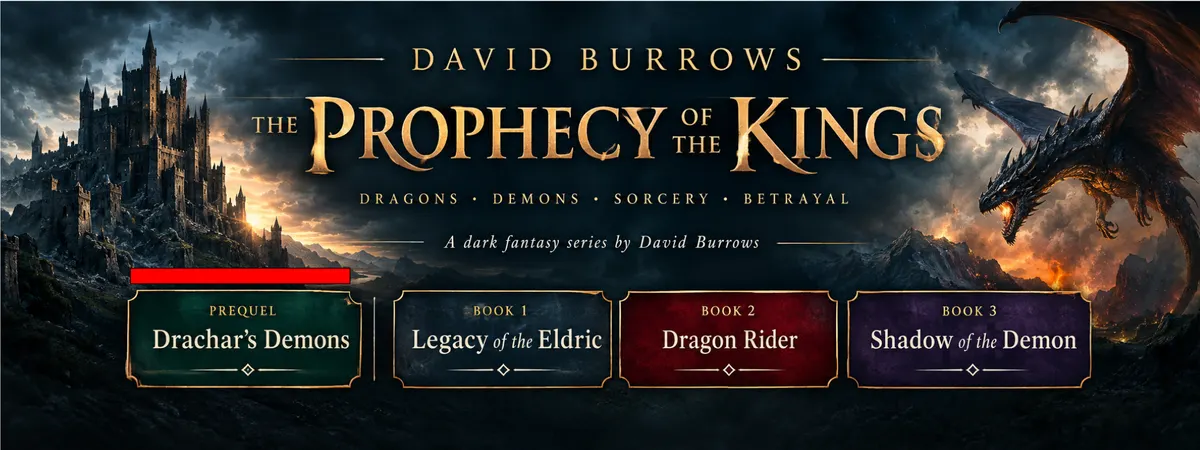
A Few of the Rules in the Prophecy of the Kings
In any fantasy tale, boundaries matter. Without them, magic becomes too convenient, danger loses its edge, and even the most powerful wizard can begin to feel limitless. One reviewer of The Prophecy of the Kings noticed that there was an easier way to end the story—an option I deliberately chose not to take. Instead, I followed a darker, more demanding path, one I hope makes the ending more interesting and more compelling. To keep that choice believable, I set clear limits on what certain characters, creatures, and powers could do. Here are some of the boundaries that shaped the world of the story.
The Difference Between a Sorcerer and a Wizard
In my books a sorcerer can be much more powerful than a wizard. Sorcerers access magic via the spirit world. At the lowest level this is summoning elementals such as air and fire. These are pretty harmless and are small sprites that can cast minor spells to cause fire, help to grow crops etc. More powerful spells are cast by demons. An imp is the smallest and least significant demon, but it can give a sorcerer access to its much more powerful cousins and then beware for if a summoning goes wrong then the summoner is dragged screaming to hell.
Wizards, by comparison, are a poorer breed of spellcaster—or so sorcerers like to claim. Their magic does not come from bargains with spirits or demons, but from a reservoir within themselves: a hidden well of power, finite and easily exhausted. Because of this, most wizards can cast only modest spells beside a sorcerer reckless enough to summon a demon. Yet there is one exception. A wizard who possesses a kara-stone is no ordinary rival. Such a stone can hold and magnify magic, allowing its bearer to draw upon far greater reserves than any unaided wizard could hope to command.
Demons
Demons come from a realm beyond the known world. Every few centuries, the veil between realms thins, and in those rare and dreadful moments the stronger demons can force their way through. They do not cross out of curiosity or conquest alone. Demons harvest souls, feeding on them to survive the long ages between crossings, and so each incursion leaves behind stories of vanished villages, broken kingdoms, and summoners who screamed themselves into legend.
Their magic is vast, subtle, and treacherous. A demon rarely grants power without twisting the bargain, yet there are always sorcerers hungry enough—or desperate enough—to seek it. To them, demon-magic is the shortest path to greatness. To everyone else, it is a door that should never be opened.
Kara-stones
No one truly knows what kara-stones are. Some say they are the crystallised remains of a dead wizard’s inner well of magic, hardened after death into something that can still store power. Others whisper a stranger tale: that the stones are fragments of a deceased Kalanth, one of the old demigods. Most dismiss this as superstition, for demigods cannot die. Surely they cannot. Yet the stones remain, cold to the touch until magic wakes within them, and no scholar has ever explained why they sometimes pulse like a distant heartbeat.
Dragons
Dragons are the true crux of the matter. Like demons, they come from another realm, but unlike demons they wield no magic at all. They do not need it. Flame, venomous vitriol, talons, and scale are weapons enough, and worse still, dragons appear to be immune to magic. That single fact terrifies both wizards and sorcerers, because it renders their greatest powers almost useless. As one sorcerer asks herself in the book, “How do you kill a dragon?” It is not an easy question to ask, and it is a far more dangerous one to answer.
Shaol
A shaol is a guardian spirit, and every person has one. For most people a shaol is simply a feeling of deja vu. Some people share a far stronger link to their shaol than others. The Priests of Ryoch, as an example, become better warriors because their shaol communicates with them, warning them of danger. The strongest link of all allows a warrior and their shaol to communicate across an entire battlefield — a bond that turns the Priests into near-unstoppable warriors. I do, however, expand on that for a very few individuals. In a very rare case, the shaol is that of a fetus, say that of a twin, absorbed in the womb. That allows the person’s spirit direct access to the astral plane and from there — they can turn their newfound power to good or ill.
Reader Comments
No comments yet — be the first to share your thoughts.